Introduction
Sangha Finder began as an exploration of what it means to "take care of one's health." I chose to narrow that broad prompt down to mental health, and specifically to how mindfulness and meditation practices could be supported by better product design.
My role: End-to-end UX/UI design — research, personas, information architecture, wireframes, visual design, prototyping, and usability testing.
The project took 6 months to complete.

Sangha Finder: A UX Case Study
Connecting solo meditation practitioners with community to foster shared accountability and ease social isolation.
The Problem
Meditation and mindfulness apps are everywhere, but most are built around solo, in-app practice. Through research, a gap became clear: people who meditate on their own often struggle with consistency, accountability, and connection.
The question that shaped the rest of the project was:
How might we help solo meditators find or build a group to practice with, to improve accountability and counter loneliness?
The resulting concept, Sangha Finder, is a matching tool that connects people to local meditation and mindfulness groups, studios, and classes that fit their goals — turning a solitary habit into a shared one.
Research
Competitive Analysis
I reviewed four established mental-health and meditation apps to understand what the market already did well and where the openings were. A few consistent findings emerged:
-
The apps were functionally similar and largely successful, users reported reduced stress, better sleep, and stronger meditation habits.
-
The clearest point of differentiation between them was age group targeting, suggesting an opportunity to design around a specific life stage rather than trying to serve everyone.
-
Pricing was consistent across the board, but user reviews frequently pushed back, subscriptions felt too expensive without enough free content. This pointed toward exploring a donation-based model as an alternative.
-
Personalization and a range of content for different skill levels (beginner through advanced) were features users judged apps by most.
-
Progress tracking over time was another feature worth carrying into a new product.


Primary Research: Interviews
Background:
This research looked at how people cope with everyday stress without seeking therapy, starting with a focus on meditation apps and broadening into general mental health, common stressors, and coping strategies.
Research goals:
-
Understand what people currently do to manage daily stress, and why.
-
Identify unmet needs that a product could address.
-
Explore comparable products and how they might be improved or monetized (e.g., subscriptions).
Research objectives:
-
What's currently causing distress in people's lives?
-
What tools or resources are they already using, if any?
-
How have stressors shifted across different ages and life stages?
-
What has their experience with mindfulness/meditation been like?
Method:
Six interviews conducted remotely with professionals aged 35–49, mostly working in the visual effects and creative industries.
Key Findings

Key stressors identified included work deadlines, financial instability in creative fields, and social isolation.
To cope, users integrated physical activity and hobbies with mindfulness, though consistency remained a challenge.
In terms of digital tools, there was a clear preference for sleek, customizable platforms with short, effective sessions like Calm or Insight Timer.
While mental health is prioritized as essential for balance and confidence, participants remain wary of subscription fatigue and the potential for self-help guilt.
Telehealth is valued for its convenience, though face-to-face connection is still preferred for personalized care.
Personas
Research findings were synthesized into three personas representing different relationships to stress, mindfulness, and technology.

John — "The Overworked Creative"
46, Marketing Manager, Los Angeles, CA · Partnered, no children
-
Goals: Reduce stress; replace stress eating and drinking with healthier coping mechanisms; build a more grateful mindset; grow his social circle.
-
Motivations: Wants stability, emotional balance, and a greater sense of control over his mental health; fears burnout or job loss.
-
Challenges: Long, unpredictable work hours; isolation as friends move away and family lives far off; difficulty focusing during longer meditation practices.
-
Needs: Ways to connect creatively and socially outside of work; encouragement to stay consistent without feeling pressured; short, engaging stress-relief tools.
-
Technology usage: Prefers flexible, short-form app features and story-based audio over guided meditation.
Maya — "The Reflective Creator"
35, Graphic Designer, San Francisco, CA · Single, no children
-
Goals: Balance mental wellness focus without over-analyzing it; maintain calm and creative flow day to day; build a more grateful mindset; make more time for meditation and walking.
-
Motivations: Seeks inner balance and emotional regulation through a grounded, realistic (not rigid) approach to mindfulness; prefers self-guided exploration.
-
Challenges: Easily overwhelmed by negative news and family stress; skeptical of over-relying on mental health apps; financially cautious about subscriptions.
-
Needs: Healthier coping mechanisms; free or low-cost options that feel sustainable; social connection and time with pets/nature; tools that complement a creative lifestyle.
-
Technology usage: Prefers free or low-cost apps with optional paid features and adjustable audio stimulation (volume, frequency).
Alex — "The Analytical Achiever"
39, Film Producer, London, UK · Partnered
-
Goals: Build genuine self-confidence and more positive self-talk; develop practical coping skills for daily stress; maintain consistent sleep and relaxation routines.
-
Motivations: Values measurable progress and efficiency; wants to optimize mental and physical performance; believes in self-improvement through tools and data; finds therapy hit-or-miss depending on the therapist.
-
Challenges: Irregular work hours disrupt consistency; loses motivation without immediate feedback or progress tracking.
-
Needs: Evidence-based, measurable results; the ability to customize session length and intensity; integration with existing tech (e.g., Apple Watch); appreciates free trials and yearly payment options.
-
Technology usage: Prefers apps with biometric feedback and performance insights, and good, appealing design.
Design Concept
With research pointing clearly toward connection and accountability as the real gaps in the market, the guiding design question became:
How might we help solo meditators find or build a group to practice with, to improve accountability and counter loneliness?
The core solution: a matching system that connects people to groups sharing similar goals, turning meditation from a private habit into a shared, supported practice.
Sangha Finder goals
-
Grow subscribers in the self-help/spiritual space
-
Increase app downloads
-
Earn positive reviews
-
Build company partnerships
-
Support product/event promos
Common goals (business + user)
-
Become the go-to hub for meditation practitioners
-
Deepen meditation experiences and community connections
-
Stay affordable and accessible to all
User goals
-
Improve their practice
-
Connect with others
-
Stay motivated
-
Join affordably
-
Feel safe
Technical considerations
-
High customization
-
Integrates with other apps/device stats
-
Privacy considerations (e.g., location data)
-
Identity protection
-
Backend scalability
-
Multi-language support


Design Process
Storyboarding & Site Mapping
Early concepts were sketched through storyboards to walk through the core user journey, followed by a site map to establish the app's overall structure and navigation logic.

Key task flows were mapped out to define how a user would discover a group and engage with it. This included search, filtering, and the messaging experience .
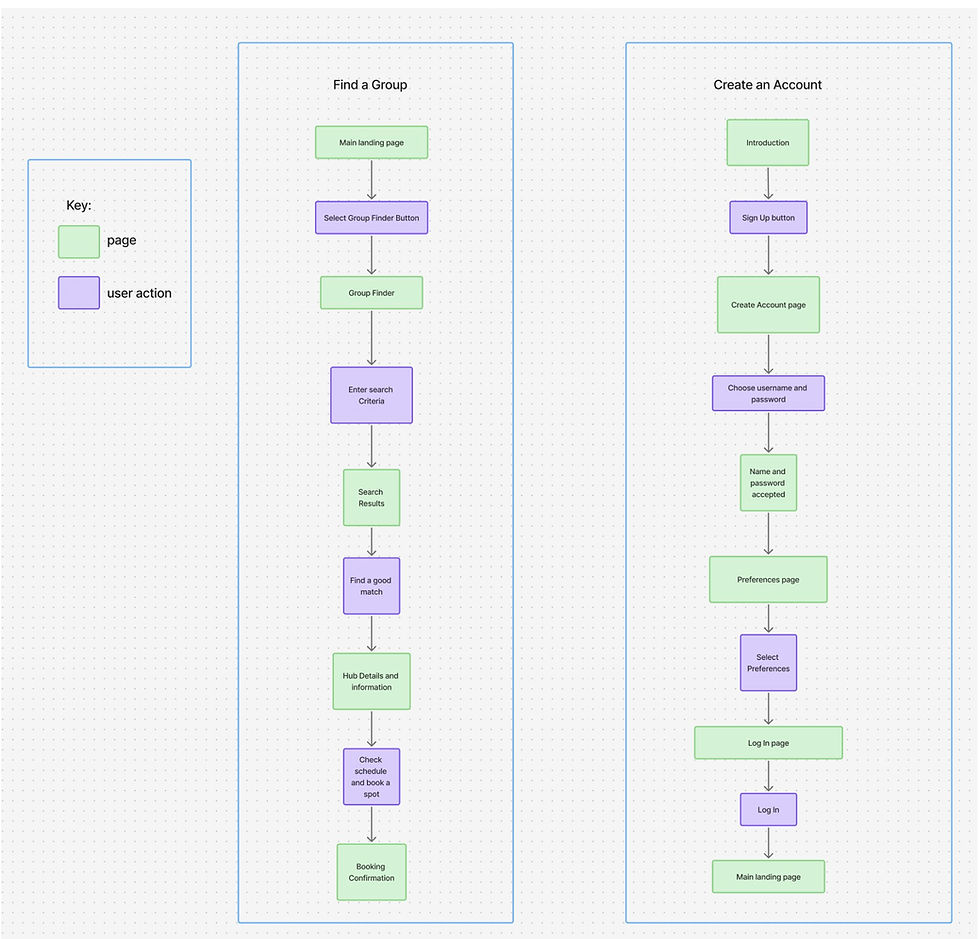
Task Flows
Wireframes translated the site map and task flows into structured screens, covering the core experience end to end:
-
Main landing page — a personalized home feed (news, recommendations, notifications, events)
-
Search — recent searches, live typing, and filtered results
-
Search results — sortable list with distance and preview details
-
Detailed group/studio view — full description, address, contact info, map, and social proof ("Followed By")

Mid-Fidelity Wireframes
Visual & Brand Design
The visual identity needed to communicate the emotional core of the product: belonging, connection, kindness, and welcoming, while staying simple, approachable, and peaceful rather than clinical.
Brand pillars:
Accessibility · Approachability · Belonging · Connection · Simplicity · Directness · Discovery · Peace · Empathy · Personal development


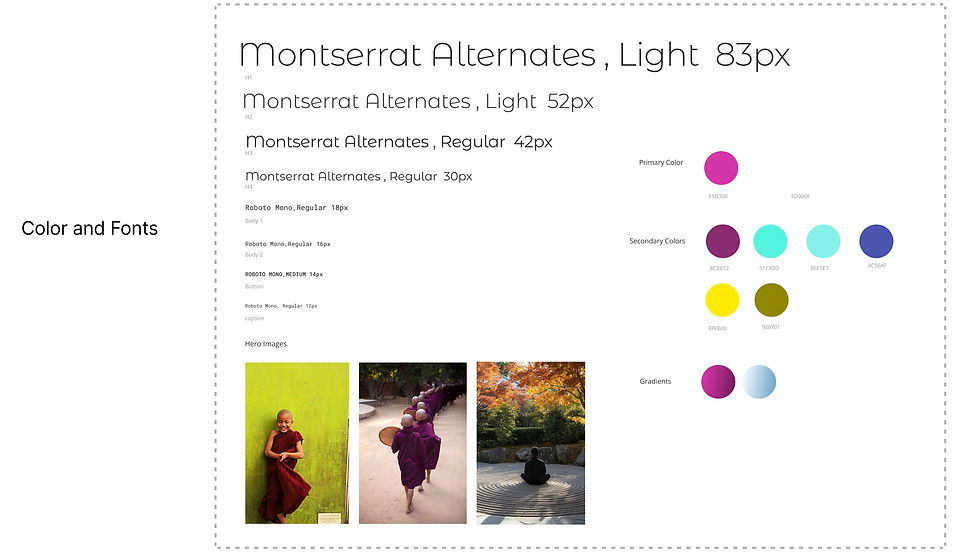
High-Fidelity Design & Prototype

The visual design system was applied across the full flow. This included landing page, search, search results, and detailed studio pages (using a sample studio, Mindful Place, as the example).
Usability Testing
Method: Five participants, ages 14–46, each completed two task flows.
Task Flow 1: Find a group and add it to favorites
-
Discover the Group Finder from the main landing page
-
Identify a good match based on details and schedule
-
Save the group to favorites
Success measures: users can locate and access the Group Finder; understand how to enter and refine search criteria; confidently select and favorite a group; minimal confusion or backtracking.

Task Flow 2 : Receive and respond to a new message
-
Find and access messages
-
Understand the Message Center layout
-
Read existing messages and respond
-
Create a new message thread
Success measures: users find their messages; successfully type and submit a response or start a new thread; return to the message center on completion.

Key Findings & Iterations
Testing revealed several small but high-impact usability issues, some flagged by multiple participants:
-
Icons needed text labels
-
Hubs button replaced with Favorites (new Favorites page added)
-
Bottom nav (Home, Mail, Favorites) made sticky
-
"Following" scroller made sticky at top of home screen
-
Search bar needed more visual prominence
-
Sent folder added to Message Center
Future considerations:
-
Expand beyond meditation to include yoga studios
-
Add more visually engaging elements
-
Use color/animation to highlight new items or CTAs
What Changed?


Reflection
Sangha Finder started from a broad, almost abstract prompt "take care of your health" . Research is what gave it direction. The interviews were the turning point. What people needed wasn't another solo meditation timer, but a way to feel less alone in the practice.
Designing around connection and accountability, rather than just content and features, shaped every decision from there: the matching concept, the community-oriented home feed, and even the warm, welcoming visual language.
Usability testing reinforced a simple lesson: small friction points (an unlabeled icon, a non-sticky nav bar) can undercut an otherwise solid concept. The iteration round was a good reminder to keep testing lightweight, frequent, and focused on real tasks rather than general impressions.
Next steps I'd explore: expanding the studio directory to include adjacent practices like yoga, building out the group-matching algorithm itself, and testing a donation-based or freemium pricing model against the subscription concerns raised in research.